Showing posts with label Douvrin. Show all posts

4 October 2015

99 - Sennelager, 7 december 1915 (Letter from friend Musketier Otto Mertens)


Sennelager, 7/12.1915

Dearest family Limbach,

Enclosed I send you, as promised, the photograph [of Fritz's grave].
Unfortunately it did not turn out very good. But that can unfortunately not be changed anymore, and you will have to do with what little there is.
Here the Dienst is quite exhausting, and fills the whole day. Therefor I have almost no time to write even the most urgent letters.
But it is a lot better here than in the trenches.
Warm greetings from your’s faithfully

Otto Mertens


On a personal note: I find this an ice-cold letter!
the complete opposite of his letter of 20th October.
And he was not wrong with “the photograph didn’t turn out very good” !:


Fritz's grave at the Ehrenfriedhof in Douvrin


From left to right:
Richard Emmler
Wilhelm Altenbach
Fritz Limbach
Karl Romberg
Eduard Siesskind
Nikolaus Wendling


the original letter:


25 September 2015

89 - 25 September 1915 (Regimental History)


25 September 1915
[Saturday]

From the Regimental History of IR16

On 21 September the enemy started firing his artillery. The trenches, that is the approach-trenches and the land behind those up to Douvrin, were under heavy fire. With interest the reserve bataillon III/16, which was at the time involved in peaceful exercises on the other side of Douvrin, watched the proceedings along the whole front upto Arras.
The structure of the trenches stood the test spendidly. Where the enemy managed to cause considerable damage, especially in the 2nd and 3rd line, this could usually be repaired under the cover of darkness. Thus large parts of the trenches were still usuable.

Deserters and prisoners had predicted a large enemy attack for 25th September. The enemy had considerably damaged the barbed wire defence and the front of our trenches with their trenchmortars, and in places completely eradicated it. Thus it could not be denied anymore that the enemy was planning an attack any time soon. II and I batallion were in the frontline trenches, III batallion was scheduled to relieve I batallion in the morning.

25th September started remarkably quiet. III batallion had already marched out for the relief. Then suddenly, at 06.45 in the morning, thick, yellow gasclouds rolled towards our positions and shrouded everything in an impenetrable haze. Gas-alarm! Everyone scrambles for the gasmasks, and sets fire to the trenchdefences. In no-time the trenchdefences along the whole line were on fire. An imposing sight! Suddenly the enemy artillery fire switched to the land behind the trenches, giving the brave defenders time to regroup, under the protection of the wall of fire, and wait for what was coming.
Several people suffered greatly from the gas, and here and there the commanders had to step in to bring the partly heavily shaken men back to their senses.  
After about 45 minutes, with the cloud slowly disappearing, the English get out of their trenches and are subjected to devastating machinegun- and rifle-fire. They don’t get far, and, after suffering heavy casualties, hastily retreat to their trenches. At the Prellbock it comes to fierce handgrenade-fights, which all end in victory for us. No Englishman reached our positions.

A company-commander writes about his impressions as follows: [From a position between the Canal and Hohenzollern Redoubt]
“As per schedule III/16 marched out of Douvrin at 5 o’clock in the morning of 25 september 1915, to relieve I/16. When the batallion was partly in the front-line trenches, and partly still in the approach-trenches, there was heavy artillery fire all of a sudden. We initially thought that the enemy had noticed the relief, when an unknown smell perplexed us. After the initial surprise it was clear: Gas-attack. As we were well prepared, with a sufficient supply of gasmasks, and trained through instructions and drills, everyone quickly recovered from that first fright and reached for their gasmask.But where were the trenchdefences? They were mostly destroyed by artilleryfire. Here and there though there were parts still intact, and they were quickly set alight.
We knew that from behind the gasclouds the enemy would come. Then, through the haze, one suddenly sees the evil enemy approaching, calmly as if they were going for a morningwalk. But he had not reckoned with the Hacketäuern. Frantic rapid fire erupted along the entire front, and the enemy rapidly retreated to his own trenches. One spirited commander had, ahead of his troops, reached the “Monocle” [a mine-crater called “Monocle”-Eyeglass], with exemplary bravery. He paid for this bravery with his life.
We had won! An uplifting moment. The brave Hacketäuer yelled “Hurra”, and even the gas casualties joined in. There were cheers and joy, the enemy had been properly paid back.
Our first worry was now to re-organise our left wing. There there were two batallions in a place which would normally hold one batallion. We then prepared to repel a possible further attack. The trench defences were repaired, wood was prepared and many a fine dug-out door,and many a fieldbed was offered to the axe. But there was a bigger worry for the commanders. The gas had affected the rifles in such a way that the locks would not function anymore. Copious grease, sourced from the batallion, remedied this shortcoming. We were ready for everything now, but the enemy remained very quiet. They had had enough and realised it was best not to tangle with us.
On the left though they had had greater success. It worried us a great deal, especially at night when we could see their flares almost behind us. The following days the battle raged on day and night, and it was reassuring for us to see the enemy bit by bit being pushed back to their old positions.“


“Casualties for the period of 1 september to 31 october 1915:
Dead: 4 officers (including 2 doctors), 189 NCO’s and men
Wounded: 4 officers, 505 NCO’s and men
Missing: 14 NCO’s and men
Furthermore 84 incapacitated by gas”.

12 September 2015

80 – Douvrin, 12 September 1915


80 – Douvrin, 12 September 1915
[Sunday]
Prellbock, 15 September 1915 . Forgot to post this letter!

Dear family,
I received mother’s letter of the 5th, and parcels nr 311, 314, 315. Many thanks for eveything.
I believe I already replied to that letter, so I don’t have much to write about today.
One thing: Mais would like a print from every photograph, can you bring those to them please.
Heiny Mais sent for a roll of film, and used it all up. The Mais’s will have it developed and printed themselves, and they will bring you a print of every photograph.
This morning we had Bataillonsexerzieren [Batallion-drill]. Nowadays a whole batallion is at rest, it used to be only 3 companies at a time. It was fun and interesting this morning, not at all as bad as I thought it would be. Bit by bit we are trained again for mobile warfare. But I believe that that is to be much preferred over this boring trench warfare, but it will also be a lot more demanding.
Tomorrow we’re going on a pleasure trip. I won’t write you where to yet. You’ll be getting a postcard from there tomorrow. It will amaze you, because there is still a war going on?
Unofrtunately I don’t have much money left. When we come into rest the next time we’ll probably move on. Please take that into account. You need a lot of money here if you want to get something extra. Everything is so expensive, and there are days that you don’t receive any parcels so that you háve to buy something. You’ve got to know that, when parcels arrive, this poor soul will not rest untill he ate everything.
In the trenches the mail always arrives at around 11 at night, and when I then get back from guardduty I can’t help myself to heat up and exterminate all the vegetables and meat, or whatever it was you sent me.
Everybody does that. We dó get something to put on our bread here, cheese, ham, sausage, tinned meat, everything really nice and tasty, and also, and that will amaze you, marmelade almost every day. It gets you through the day, but it’s not quite enough really.
Furthermore we get something to smoke every day, Horchpostenzigarren [= not very good cigars] and Cycle cigarettes, made in America, and as strong as two horses. [*1]  Where they found thóse……  We’re getting the same for months already. Work it out: 3 cigarettes per person just about every day, and that’s not just óur Company.
I have a little job now, for one night only, when we’re in the trenches: making two signs with “Stennes Graben”on it. For that I need the whole night of course. And I rustled up a candle from the Feldwebel, and 20 cigarettes from the Leutnant.
I’ll draw it for you, so you see which genial font I’ve used:


Much better in real life of course. Now, don’t my artistic skills leave you breathless? Yeah, the skills you need to have when you’re with the Prussians.
I can hear father now: “All those big letters, surely you can’t read those”
With many warm greetings
Your Fritz
I tensely await Hanne’s letter.


[*1] Cycle cigarettes


The original letter:


27 August 2015

75 - Douvrin, 27 August 1915


Douvrin, 27 August 1915
[Friday]

Dear family,
Yesterday I received mother’s letter of the 22nd and parcels nr 283 (arrived in good order), 284, 285, 286, 287, 288, 289. Many thanks for everything.
I am sorry that Helene had such bad weather in the Sauerland. Over here is was beautiful weather all the time. So I won’t need protection against rain for the time being. The juice that Helene sent was nice. But she doesn’t have to wet my lips again with berry-wine! I received the second silk shirt already a long time ago, as I have written you. It’s in the wash at the moment.
I think you can guess the reason why it’s not going forward yet here in the West, or haven’t you heard anything yet? Please write me what you think of it. Then I’ll tell you whether you’re right or wrong.
I have already written to Aunt Bonert, and got a parcel with letter in reply yesterday. Didn’t she tell you that? I’ll let loose a postcard to Reverend Herbst’s wife right away.
That the one with an Iron First [Iron Cross-First class] and Second  [= Leutnant Stennes] has received mother’s parcel does me good. The Iron Cross Second class is really nothing special anymore. If you see who get’s awarded that Cross it really does not interest you anymore.[*]
But the Iron First is something completely different. Especially when you see that not one officer had been awarded one yet, so it has to be something very special.
An Unteroffizier [= Sergeant], then still a Musketier, from our Kompanie was awarded one for his actions at Neuve Chapelle. He managed to retrieve some 20 wounded from near the English trenches. We now have 2 EKI’s and 52 EK2’s in our Kompanie of less than 100 men. That is rather special, isn’t it?
Haven’t got any news to write you. We really enjoyed our 5 days rest this time. This morning we went swimming. The embankment is now a little overgrown with waterplants, so it’s not as nice there as it was before. And we are being deloused now every time we come into rest, clothes, gear etc. Everything is fumigated. Gradually you start to notice it does help a little. I don’t have lice at the moment at least. Which is more luck than wisdom.
By the way: turned out we don’t have the French opposite us, as I wrote you, but still the English.
There’s a rumour that the English artillery has been shipped to the Dardanelles. Whether that’s true or not I don’t know, but it doesn’t sound impossible to me.
A lot of artillery has been sent here from Russia. We hear them rumbling through the streets almost every night.  It can only be a good thing to have some more artillery here: it keeps Tommy nice and quiet.
But I ‘m at the end of my wisdom. Please ask questions in the next letter.
With many warm greetings to all acquaintances  Your  Fritz

[*]
“During World War I, approximately 218.000 EKIs, 5.196.000 EKIIs and 13.000 non-combatant EKIIs were awarded.”


The original letter: 

25 August 2015

74 - Douvrin, 25 August 1915


Douvrin, 25 August 1915
[Wednesday]

Dear family,
I received mother’s letter of the 18th, and father’s letter of the same day with the photographs; furthermore parcels nr 278, 79, 80, 81, 82, and a parcel from Helene [his sister] from Dingeskirchen im Sauerland [*1]
Many thanks for everything, expecially the photographs.[2]
Today I’ll send you filmroll nr 3, with these exposures:
Nr 1/11 groups and persons at the Prellbock, nr 6 with the French machinegun at the Prellbock.
Nr 12 just unknown Grandées, taken in front of our quarters in Douvrin.
They’re all timed exposures, hopefully wíth heads this time. I hope a new roll of film is on its way to me already. I don’t think you can send me enough film, when you see the number of men who’ve already come to me and réally like to be photographed.
Don’t you have any questions about the photographs? I really miss that, if you ask questions I finally have something to write about. It’s getting a little boring for you, I think, when the only thing I write is : “Tommy is quiet.” And for the rest nothing much happens here.
To the three questions from mother’s letter: Karl Steigleder díd get the Puffertkuchen. I remember vividly how we shared them. They tasted great. It will have been 2 or 3 days before [before Karl was killed], I don’t quite know exactly anymore.
The poor and sad looking man on photograph nr 19 is in reality neither poor nor sad. He is our esteemed Company’s barber from Solingen, who, a fact unknown to most, receives the most parcels of anyone at the Prellbock. The other two guys on that photograph are members of the M.G.K. (Mordgesellenklub) [*3], but véry friendly guys nonetheless.
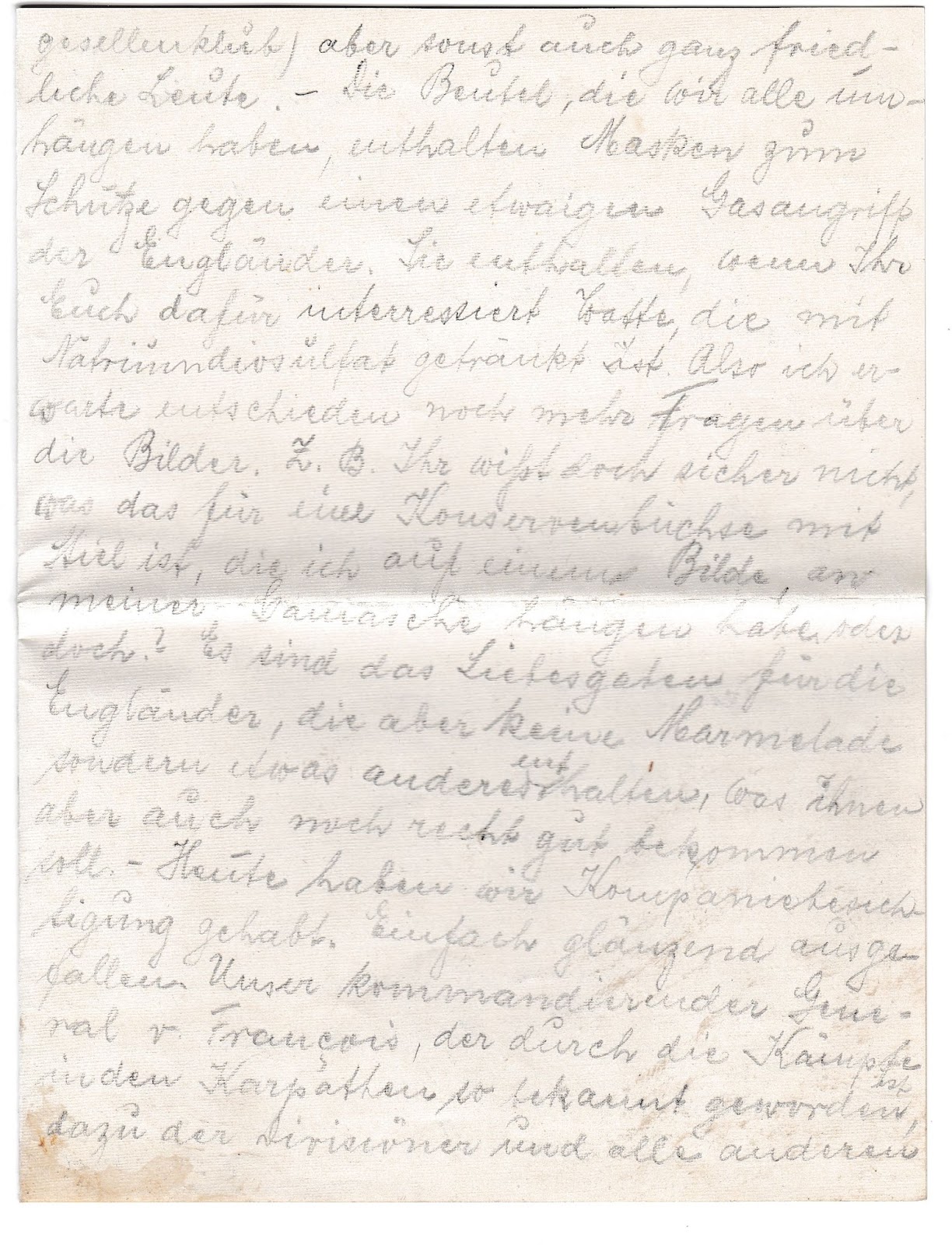
The little bag we’re all carrying contains a mask to protect us against English gas-attacks. They contain, if that interests you, cotton wool soaked in Sodium-Diosulphate.
So, I wait for more questions about the photographs. For example: you don’t really know what that tin with a handle actually is, do you? I have one hanging from my Gamaschen on one of the pictures.
They’re presents for the English, not containing marmelade but something of a different composition, which I’m sure they will also like very much.
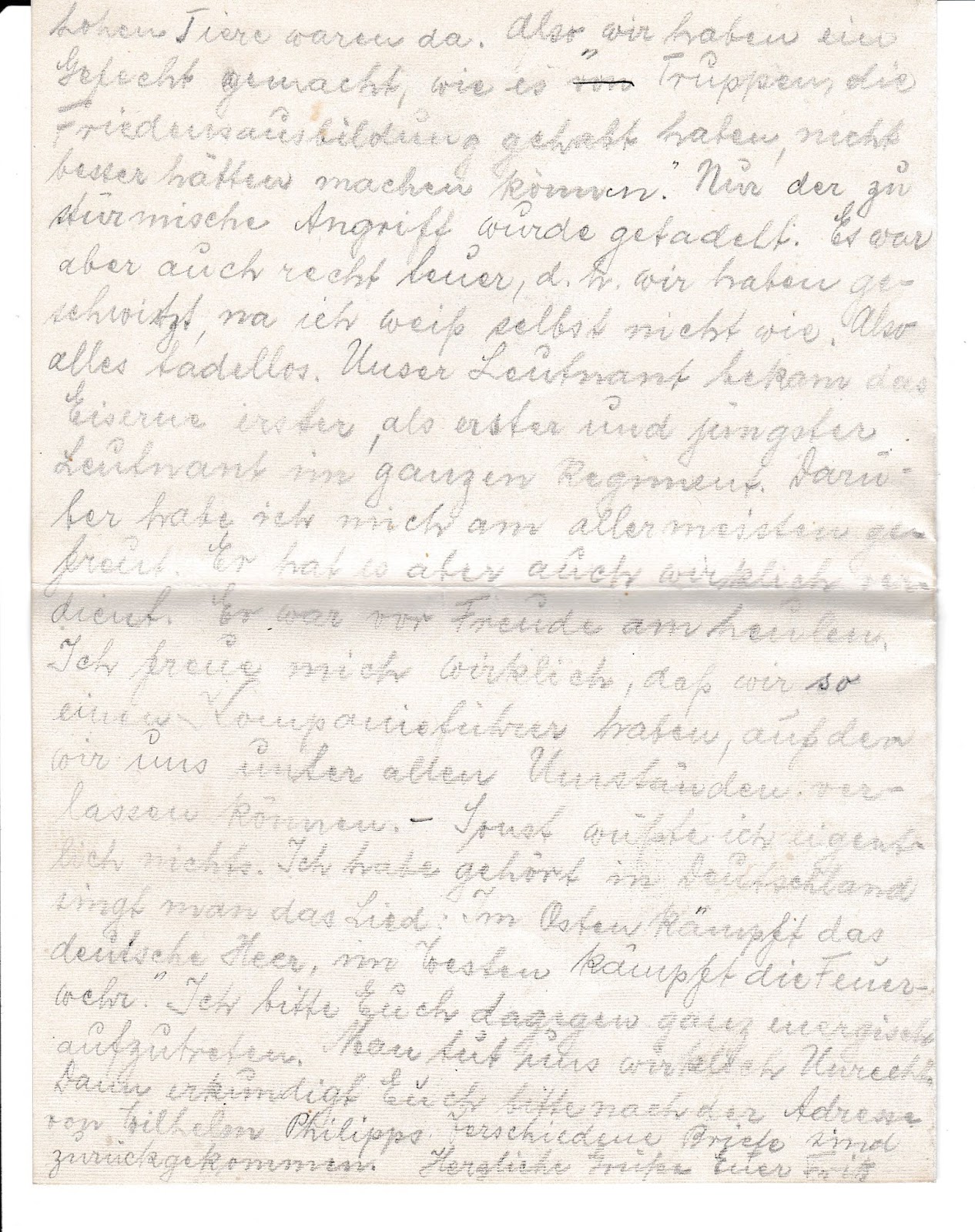
Today we had our Kompanies Inspektion. It was just brilliant. Our commander General von François, who got so well-known because of his role in the battles in the Carpathian Mountains, the Divisional Commanders and all other high animals were there.[*4]
We staged a mock battle, and the troops, which had been trained in peace-time, could not have done better. Only the somewhat too boisterous attack was repelled. It was really tough, I mean we sweated like I don’t know what. But all was perfect.
Our Leutnant [*5] received the Iron Cross 1st Class, the first and youngest Lieutenant in the whole Regiment to receive that honour. I was so happy for him. He truly deserved it. He cried tears of joy.
I’m very happy to have such a Company Commander, one you can rely on in all circumstances.
Don’t know what else to write. I heard people in Germany sing “Im Osten kämpft das deutsche Heer, im Westen kämpft die Feurwehr” [*6]. I implore you to be véry strictly against that, it really is injust towards us.
Please try to get Wilhelm Philipps’s address. Several of my letters were returned to me.
Many warm greetings  your Fritz

[*1] Dingeskirchen is not a real place, it means “what-was-the-name-again” or “Thingy-church”. Something like that.

[*2] The photographs his father sent must have been the second batch of copies for his mates.

[*3] M.G.K.: Machinen Gewehr Kompanie , Machine gun company
Mordgesellenklub”: Hitsquad (of the mafia e.g.)

[*4] 
General Hermann von François :

Commander of the 13th Division : Generalleutnant Kurt von dem Borne

Commander of the 14th Division : Generalmajor Constantin von Altrock  https://de.wikipedia.org/wiki/Constantin_von_Altrock

[*5] Walther Stennes :

[*6]
Im Osten kämpft das deutsche Heer, im Westen kämpft die Feuerwehr” :
“In the East the army engages in real battles, in the West the army just puts out little fires”


The original letter: